By Richard Wolf, USA TODAY
WASHINGTON — President Bush will propose on Monday spending nearly $300 billion more through 2009 for the war on terror, which is dominated by the war in Iraq, a senior administration official said today.
The funding, sure to be closely scrutinized by Congress, will include:
•$100 billion for the 2007 fiscal year ending Sept. 30, which when added to spending already in the pipeline would bring the year's total to $170 billion.
•$145 billion for 2008, a figure derived from this year's troop levels and expenditures.
•$50 billion to get started on 2009. More funds likely will be needed.
This marks the first time the administration has estimated war costs so far ahead or been as specific about how the Pentagon and State Department intend to spend the money. The added detail is a response to past criticism from Congress. The senior official has direct knowledge of the budget plans and did not want to be identified because the fiscal blueprint has not yet been officially released.
WAR SPENDING: Experts worried about budget's scope
Since 2001, the United States has spent or will spend at least $504 billion on the war on terror — including $334 billion on Iraq, according to the Congressional Budget Office. The latest spending proposals will push the total over $800 billion. The 2008 estimate is $25 billion lower than the 2007 total because it does not include as much money for fixing and replacing equipment, the official said. It also does not include money for the additional 21,500 combat troops being sent to Iraq under Bush's new war plan. The administration estimates the troop increase, which will be covered by existing funds, will cost $5.6 billion; the Congressional Budget Office says it could cost at least $13 billion.
The additional requests for funding will come in two forms: a $100 billion supplemental budget bill for 2007, and the president's 2008 budget. Both will be delivered to Congress on Monday.
The Democratic-controlled Congress has promised to closely vet all new spending on the Iraq war. House Democrats have proposed making dramatic changes in how the money is spent, diverting money from Iraq to be used for military readiness at home. In particular, Democrats and Republicans alike have been critical of spending on reconstruction in Iraq. The budget also will include an increase in spending on veterans, largely for medical care as troops return from Iraq and Afghanistan. The Department of Veterans Affairs will get the largest percentage increase of any domestic agency, the administration official said.
Other highlights of the proposed fiscal 2008 budget, expected to top $2.8 trillion:
•The expected increase in Medicare spending would be trimmed by $66 billion, nearly twice the savings Bush sought last year. Higher-income seniors would be asked to pay more for doctors' bills and prescription drugs. Most of the other cuts would affect hospitals, doctors, clinics and labs.
Even with the reductions, Medicare spending would rise by 6.7% annually over the next 10 years, down from a projected 7.6%.
•The maximum Pell grant for low- and middle-income college students would increase from $4,150 to $4,600 in 2008 and to $5,400 by 2012.
•A total of 141 programs will be eliminated or substantially reduced for a savings of $12 billion over five years. That's the same number of programs Bush tried to cut in the current year's budget. Most of them survived when Congress last year failed to complete the budget process.
source
Friday, February 02, 2007

Sunday, January 14, 2007
MEDAL MOM'S CALL TO BACK THE TROOPS
By DEB DUNHAM
January 14, 2007 -- Marine Cpl. Jason Dunham, 22, was posthumously awarded the Medal of Honor by President Bush on Thursday for saving several men in his unit when he jumped on a grenade in Iraq. His mother, Deb Dunham, a teacher in upstate Scio, tells her memories of him.
I'll leave it to others to debate the politics of the war in Iraq. I'm a mother, not a politician. For me, discussing my son is personal, not political.
I want to remember Jason and to offer some thoughts to other parents whose sons and daughters are in combat serving this country.
There were so many facets to Jason's personality, you can't lock into any one thing.
He had a mischievous sparkle in his eye. You could play a joke on him and he would roll with it, but you could be pretty sure that he would come back with something when you weren't expecting it.
He was competitive and sports were often the way that he channeled that spirit. Jay played soccer, basketball and baseball - he still holds his high school's record in baseball.
Jason's teams often won. When he won, he wouldn't make the other team feel bad. He would congratulate his teammates and then go shake hands with the other team.
But it was his quiet sense of kindness that I remember most. He would always want to help out the little guy, the underdog, even when he was young.
Jason received the Medal of Honor for sacrificing himself to save others. What he did is great. But my son would have said, "Oo-rah! Let's go have a beer."
There was always one more challenge for him to find and meet in his life.
Like many families across America, my husband Dan and I would not have been able to afford college for our four children. Jason knew that and in the summer of his junior year in high school, we would sit in the living room and talk about what he wanted to do.
My husband was in the Air Force and he believes that everyone should serve a few years in the military, because it polishes you.
So Jay went into the Marine Corps - because it's the toughest training and something he could hold over his father's head. He'd say, "I work in the men's department of the military."
Jason joined the Corps before 9/11, but he believed in what he was doing in Iraq.
His sense of right and wrong was keen. He thought that when someone has a lot of power and a lot of strength, you have a responsibility to help the little brother.
I just miss him.
For those parents who still have children in Iraq, I say, support your child.
This is a volunteer military that we have - these men and women have more courage, more dignity and more patriotism than I have seen in years.
Take the phone calls, send the letters and the care packages. They know you are scared, but they don't need to go through two types of war.
It's not a political issue when it's your child. They are doing what they believe is right.
Jason may be gone, but we've gained thousands of new sons.
That has helped the healing for us.
source
January 14, 2007 -- Marine Cpl. Jason Dunham, 22, was posthumously awarded the Medal of Honor by President Bush on Thursday for saving several men in his unit when he jumped on a grenade in Iraq. His mother, Deb Dunham, a teacher in upstate Scio, tells her memories of him.
I'll leave it to others to debate the politics of the war in Iraq. I'm a mother, not a politician. For me, discussing my son is personal, not political.
I want to remember Jason and to offer some thoughts to other parents whose sons and daughters are in combat serving this country.
There were so many facets to Jason's personality, you can't lock into any one thing.
He had a mischievous sparkle in his eye. You could play a joke on him and he would roll with it, but you could be pretty sure that he would come back with something when you weren't expecting it.
He was competitive and sports were often the way that he channeled that spirit. Jay played soccer, basketball and baseball - he still holds his high school's record in baseball.
Jason's teams often won. When he won, he wouldn't make the other team feel bad. He would congratulate his teammates and then go shake hands with the other team.
But it was his quiet sense of kindness that I remember most. He would always want to help out the little guy, the underdog, even when he was young.
Jason received the Medal of Honor for sacrificing himself to save others. What he did is great. But my son would have said, "Oo-rah! Let's go have a beer."
There was always one more challenge for him to find and meet in his life.
Like many families across America, my husband Dan and I would not have been able to afford college for our four children. Jason knew that and in the summer of his junior year in high school, we would sit in the living room and talk about what he wanted to do.
My husband was in the Air Force and he believes that everyone should serve a few years in the military, because it polishes you.
So Jay went into the Marine Corps - because it's the toughest training and something he could hold over his father's head. He'd say, "I work in the men's department of the military."
Jason joined the Corps before 9/11, but he believed in what he was doing in Iraq.
His sense of right and wrong was keen. He thought that when someone has a lot of power and a lot of strength, you have a responsibility to help the little brother.
I just miss him.
For those parents who still have children in Iraq, I say, support your child.
This is a volunteer military that we have - these men and women have more courage, more dignity and more patriotism than I have seen in years.
Take the phone calls, send the letters and the care packages. They know you are scared, but they don't need to go through two types of war.
It's not a political issue when it's your child. They are doing what they believe is right.
Jason may be gone, but we've gained thousands of new sons.
That has helped the healing for us.
source
Saturday, January 13, 2007
Medal for a Marine
This one is for the Marines. For the guys and gals in the uniforms with the red trim; for the tired, dirty, brave bunch on duty in the Middle East; for the kids in her son Jason's outfit who phone Deb Dunham each Christmas and Mother's Day, to check up on her and see how she's doing.
Jason died in Iraq in April 2004. He was a Marine corporal, leading a rifle squad on patrol near the Syrian border.
The Americans stopped a car. An Iraqi leaped from the door. Jason struggled with him. The Iraqi let go a grenade.
Jason covered the grenade with his Kevlar helmet, absorbing much of the blast. His unprotected head was pierced by shrapnel, but his sacrifice saved two of his men.
He was 22, the son of Deb, a school teacher, and her husband, Dan. He was treated in Iraq, then flown to a military hospital in Germany and on to Bethesda Naval Hospital, not far from here, where he died, as his mother held one hand and his father the other.
Jason was a high school athlete in Scio, N.Y., a rural community of 1,800 souls where his family works a dairy farm, some 70 miles southeast of Buffalo. For his bravery, he became the first Marine to be awarded the Congressional Medal of Honor in Iraq.
President Bush told Jason's story on Thursday, on a bright, cold morning, a few hours after addressing the nation with the news that the U.S. will dispatch another 21,000 troops to Iraq.
"He was the kind of person who would stop patrols to play street soccer with the Iraqi schoolchildren. He was the guy who signed on for an extra two months in Iraq so he could stay with his squad. As he explained it, he wanted to 'make sure that everyone makes it home alive.' Corporal Dunham took that promise seriously and would give his own life to make it good," Bush told a solemn audience in the East Room of the White House.
Bush's cheeks glistened with tears.
"With this medal, we pay tribute to the courage and leadership of a man who represents the best of young Americans," the president said. "With this medal, we ask the God who commands us to love our neighbor as ourselves to wrap his arms around the family of Corporal Jason Dunham, a Marine who is not here today because he lived that commandment to the fullest."
The East Room was not short of heroes for the medal ceremony. Barney Barnum and Bob Foley and Gary Littrell were there, wearing the cornflower-blue ribbon of the Medal of Honor, which they earned under fire, rallying comrades in Vietnam.
And Bob Howard, who was nominated for three Medals of Honor for his daring as a Green Beret in Vietnam, though you're only allowed to receive one; Al Rascon, an Army medic, who was wounded using his own body to shelter the shot-up soldiers under his care; and Brian Thacker, who, after helping his men beat back a North Vietnamese attack, stayed behind while they escaped, firing an M-16 and calling in U.S. artillery fire on his own position to buy them time. The young Marines in the crowd took turns, stepping up to shake their hands.
There was a reception at the White House, where a Marine pianist played a Chopin polonaise. Then the Dunhams stepped out of the West Wing.
The breeze whipped the flags at the mansion on the bright cold morning, as they walked out on the driveway. A stoic Marine, in dress uniform, stood guard at the West Wing door.
"We're very honored," Deb Dunham said. "We wish Jason could have been here.
"I wanted him here and I couldn't have him," she said, when asked what thoughts she had when accepting the medal. Just a mom, remembering, missing her eldest son.
Her husband Dan's thoughts went to the other dead and wounded soldiers who have suffered, and the other parents who have mourned. He seemed uncomfortable, being singled out.
"They are all courageous," he said. "They all have valor. They are part of this medal."
They've marched a long, emotional journey since the day in 2004 that they got the phone call, telling them that their boy had been mortally wounded, Deb said.
"I've lost my son. It still hurts," she said.
But the Dunhams are proud of their lost hero, and take comfort in the love and the sacrifice he displayed. They see in Jason's selflessness "an example of the good that is in men," said Dan. And so take comfort.
Their son didn't write many letters; he preferred to phone home to hear their voices. He talked sometimes of the cause for which he fought.
"Jason believed that all men on this earth should be free," said Dan. "As do I."
Maybe mostly, Jason "believed in his friends," his father said. In the bonds formed in combat, in a frightening and dangerous place, on a mission so far away.
Believed enough that he gave his life for theirs.
source
Bizon phone card Jupiter calling card Mozart calling card Continental calling card
Jason died in Iraq in April 2004. He was a Marine corporal, leading a rifle squad on patrol near the Syrian border.
The Americans stopped a car. An Iraqi leaped from the door. Jason struggled with him. The Iraqi let go a grenade.
Jason covered the grenade with his Kevlar helmet, absorbing much of the blast. His unprotected head was pierced by shrapnel, but his sacrifice saved two of his men.
He was 22, the son of Deb, a school teacher, and her husband, Dan. He was treated in Iraq, then flown to a military hospital in Germany and on to Bethesda Naval Hospital, not far from here, where he died, as his mother held one hand and his father the other.
Jason was a high school athlete in Scio, N.Y., a rural community of 1,800 souls where his family works a dairy farm, some 70 miles southeast of Buffalo. For his bravery, he became the first Marine to be awarded the Congressional Medal of Honor in Iraq.
President Bush told Jason's story on Thursday, on a bright, cold morning, a few hours after addressing the nation with the news that the U.S. will dispatch another 21,000 troops to Iraq.
"He was the kind of person who would stop patrols to play street soccer with the Iraqi schoolchildren. He was the guy who signed on for an extra two months in Iraq so he could stay with his squad. As he explained it, he wanted to 'make sure that everyone makes it home alive.' Corporal Dunham took that promise seriously and would give his own life to make it good," Bush told a solemn audience in the East Room of the White House.
Bush's cheeks glistened with tears.
"With this medal, we pay tribute to the courage and leadership of a man who represents the best of young Americans," the president said. "With this medal, we ask the God who commands us to love our neighbor as ourselves to wrap his arms around the family of Corporal Jason Dunham, a Marine who is not here today because he lived that commandment to the fullest."
The East Room was not short of heroes for the medal ceremony. Barney Barnum and Bob Foley and Gary Littrell were there, wearing the cornflower-blue ribbon of the Medal of Honor, which they earned under fire, rallying comrades in Vietnam.
And Bob Howard, who was nominated for three Medals of Honor for his daring as a Green Beret in Vietnam, though you're only allowed to receive one; Al Rascon, an Army medic, who was wounded using his own body to shelter the shot-up soldiers under his care; and Brian Thacker, who, after helping his men beat back a North Vietnamese attack, stayed behind while they escaped, firing an M-16 and calling in U.S. artillery fire on his own position to buy them time. The young Marines in the crowd took turns, stepping up to shake their hands.
There was a reception at the White House, where a Marine pianist played a Chopin polonaise. Then the Dunhams stepped out of the West Wing.
The breeze whipped the flags at the mansion on the bright cold morning, as they walked out on the driveway. A stoic Marine, in dress uniform, stood guard at the West Wing door.
"We're very honored," Deb Dunham said. "We wish Jason could have been here.
"I wanted him here and I couldn't have him," she said, when asked what thoughts she had when accepting the medal. Just a mom, remembering, missing her eldest son.
Her husband Dan's thoughts went to the other dead and wounded soldiers who have suffered, and the other parents who have mourned. He seemed uncomfortable, being singled out.
"They are all courageous," he said. "They all have valor. They are part of this medal."
They've marched a long, emotional journey since the day in 2004 that they got the phone call, telling them that their boy had been mortally wounded, Deb said.
"I've lost my son. It still hurts," she said.
But the Dunhams are proud of their lost hero, and take comfort in the love and the sacrifice he displayed. They see in Jason's selflessness "an example of the good that is in men," said Dan. And so take comfort.
Their son didn't write many letters; he preferred to phone home to hear their voices. He talked sometimes of the cause for which he fought.
"Jason believed that all men on this earth should be free," said Dan. "As do I."
Maybe mostly, Jason "believed in his friends," his father said. In the bonds formed in combat, in a frightening and dangerous place, on a mission so far away.
Believed enough that he gave his life for theirs.
source
Bizon phone card Jupiter calling card Mozart calling card Continental calling card
Tuesday, November 28, 2006
Springfield Marine dies in Iraq
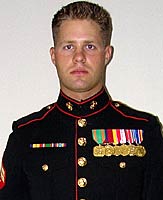 Marine Cpl. Nicholas Rapavi |
Marine Cpl. Nicholas Rapavi often told his parents that while the mission in Iraq was important, his top concern was bringing the members of his squad home unharmed. Contact staff writer Tina Eshleman at teshleman@timesdispatch.com or (804) 649-6304.
While on patrol Friday, Rapavi kept his squad back while putting himself in harm's way by going first through a gate in a situation he thought looked suspicious. He was shot in the neck, his father, Paul Rapavi, said yesterday.
"He felt like these guys depended on him and it was his responsibility to make sure they were OK," Paul Rapavi said. "He lost one of the members of his squad in September and he was devastated by that because these people were his brothers."
Nicholas Rapavi, 22, of Springfield, became the 101st Virginian to die while serving in Iraq or Afghanistan. According to the Department of Defense, he was fatally injured while conducting combat operations in Iraq's Anbar province.
Paul Rapavi said his son had served in Afghanistan and once before in Iraq. He advanced in the ranks to become a corporal and led a squad of as many as 12 Marines. Nicholas had planned to leave the Marines at the end of his four-year term in May and go to college and possibly re-enlist later, his father said.
Although not from a military family, Nicholas had wanted to be in the Marines since he was in high school."Early on, he was an avid baseball player, but when he went to high school, everything was secondary to the Marines," said Paul Rapavi, who is a dentist. He said Nicholas did everything he could to prepare himself -- joined the Army ROTC, lifted weights, did pushups, always strove to improve.
He had two younger brothers -- Jonathan, 20, and Christopher, 18 -- to whom he was very close, his father said.
"It's been especially tough for the 20-year old," Paul Rapavi said. "All his friends think of Nicholas as the true American hero. When he joined, they were saying, 'Osama bin Laden's in trouble now.' Nobody's going to get away from Nick."
Paul Rapavi described his son as outgoing with lots of friends, a natural leader. "He was a tough guy but treated people fairly. You didn't cross his brothers, but as soon as he straightened you out, he could be your friend."
Besides his father and brothers, Nicholas Rapavi is survived by his mother, Cathy Rapavi-Burnley.
Plans for a funeral service are incomplete, but his family hopes he will be able to be buried at Arlington National Cemetery, his father said.
Nicholas Rapavi was assigned to the 2nd Battalion, 8th Marine Regiment, 2nd Marine Division, II Marine Expeditionary Force, based at Camp Lejeune, N.C.
This story can be found at: www.timesdispatch.com
Wednesday, September 13, 2006
Iraq - The Right To Bear Arms
Here in the U.S., our Constitution gives every American the right to bear arms. While the Constitution says nothing about licensing, we have learned that licensing is a necessity to keep arms out of the wrong hands. It's not foolproof, as criminals know. But, licensing does stem the flow of arms into the wrong hands.
Is America more violent since licensing? Yes. But, violence has grown in America in proportion to the growth of population and the manufacture of weapons. Imagine what life would be like here if there was no gun licensing?
Does Iraq's current situation come to mind?
In Iraq, tribes, militias, private citizens, and gangs are armed to the teeth. Danger and death are daily threats for innocent civilians. No one can argue about the need to protect one's family. After all, this was the primary reason behind our own "right to bear arms". Guns were used to hunt and to protect in early America.
Iraq can be compared to the founding of our country. It took years for us to realize that our citizens would never give up their guns. As a compromise, licensing was instituted. Now, this is not to start a debate over "gun control". That debate will continue to rage in this country for years to come. Rather, this is merely to point out what Iraq needs to do to stem random violence and sectarian killing.
The Iraqi government needs to begin the process of licensing, soon. Let the people keep their weapons but make registration mandatory. Now, this should not include registration of RPG's (rocket propelled grenades), shoulder-mounted missiles, and the like, but, at some point, they need to begin the process of "search and seizure" of these mass-killing weapons. They are doing that now in connection with a crackdown on militias, terrorists, and common criminals. The average citizen should be next.
It will be up to the Iraqi government, not you or I, to determine what is "illegal". It's their call. It's their country. We cannot fathom their history of armed tribes and sectarianism. There are a multitude of religious leaders with their own small armies. It has been that way since the fall of Iraq. Can we blame them for wanting to protect themselves and their families during the chaos that followed? But, that time has passed. The new Iraqi security forces are nearly ready to take over and ensure the peace so that the Coalition can send their troops home.
Of course, I realize it won't be easy and that such a move will launch a debate over gun control in Iraq. Welcome to Democracy! Welcome to a free people deciding their own destiny, not at the point of a gun, rather with a Constitution and the Rule of Law as the new weapons of choice.
It will continue to be a struggle. Nothing great was ever accomplished by a weak people. The Iraqi's who do not falter will win the day for their nation, not the U.S., not the Coalition. We can only stand behind them to support them until they can do it without us. And, I believe, they will. The first step is weapon registration.
Jim DeSantis is a 15 year veteran of investigative reporting. He runs a Self Help Newspaper, On Line Tribune at http://on-line-tribune-front-page.blogspot.com featuring 14 sections packed with Free articles, courses, and ebooks on a variety of topics dealing with daily life. You are invited to submit your opinion on this or on any other topic to Jim's blog. If accepted, your opinion will be published as a Featured Article.
Is America more violent since licensing? Yes. But, violence has grown in America in proportion to the growth of population and the manufacture of weapons. Imagine what life would be like here if there was no gun licensing?
Does Iraq's current situation come to mind?
In Iraq, tribes, militias, private citizens, and gangs are armed to the teeth. Danger and death are daily threats for innocent civilians. No one can argue about the need to protect one's family. After all, this was the primary reason behind our own "right to bear arms". Guns were used to hunt and to protect in early America.
Iraq can be compared to the founding of our country. It took years for us to realize that our citizens would never give up their guns. As a compromise, licensing was instituted. Now, this is not to start a debate over "gun control". That debate will continue to rage in this country for years to come. Rather, this is merely to point out what Iraq needs to do to stem random violence and sectarian killing.
The Iraqi government needs to begin the process of licensing, soon. Let the people keep their weapons but make registration mandatory. Now, this should not include registration of RPG's (rocket propelled grenades), shoulder-mounted missiles, and the like, but, at some point, they need to begin the process of "search and seizure" of these mass-killing weapons. They are doing that now in connection with a crackdown on militias, terrorists, and common criminals. The average citizen should be next.
It will be up to the Iraqi government, not you or I, to determine what is "illegal". It's their call. It's their country. We cannot fathom their history of armed tribes and sectarianism. There are a multitude of religious leaders with their own small armies. It has been that way since the fall of Iraq. Can we blame them for wanting to protect themselves and their families during the chaos that followed? But, that time has passed. The new Iraqi security forces are nearly ready to take over and ensure the peace so that the Coalition can send their troops home.
Of course, I realize it won't be easy and that such a move will launch a debate over gun control in Iraq. Welcome to Democracy! Welcome to a free people deciding their own destiny, not at the point of a gun, rather with a Constitution and the Rule of Law as the new weapons of choice.
It will continue to be a struggle. Nothing great was ever accomplished by a weak people. The Iraqi's who do not falter will win the day for their nation, not the U.S., not the Coalition. We can only stand behind them to support them until they can do it without us. And, I believe, they will. The first step is weapon registration.
Jim DeSantis is a 15 year veteran of investigative reporting. He runs a Self Help Newspaper, On Line Tribune at http://on-line-tribune-front-page.blogspot.com featuring 14 sections packed with Free articles, courses, and ebooks on a variety of topics dealing with daily life. You are invited to submit your opinion on this or on any other topic to Jim's blog. If accepted, your opinion will be published as a Featured Article.
Wednesday, September 06, 2006
Was Iraq war a mistake?
Question by ash_m_79:
Absence of democracy, Weapons of Mass Destruction and support to terrorism were the reasons given for the Iraq war or which the latter two were false. In fact Bush's close Ally Pakistan becomes a fitter case for a war if these are the conditions for an Invasion. True the Taliban were asking for it for a long time, eventually someone else would have kicked their @ss if it want for America. Did Bush's personal bias against Saddam lead America to war with Iraq? Did Bush play with the sentiments of the Americans and the support of the International countries after 911? Surely The U.S wouldn't have attacked Iraq if it wasn't for 911 which we know Iraq had nothing to do with. Surely the U.S public was lied about 911 and led to a war because of one man's bias.Answers
Chainsaw:
1. We went into Iraq because we had a cease fire with Saddam after the Gulf War. Part of that was to allow weapon inspectors unfettered access. He refused. We had 19 UN resolutions. By breaking the cease fire, we voided our part (stop military action). It was then on. I watched Pres Bush talk about this before we went into Iraq.
2. No WMD's? What was gassing the Kurds? What about the missles with mustard gas that was recently announced.
3. On supporting terrorism, Al Qaida was in most countries with dictators. Do you think they were in Iran, Syria, Saudi Arabia, Afghanistan, and every other Middle Eastern country except Iraq? Think about it.
4. We would have had to go into Iraq without 9-11 because of my first answer.
I suggest taking the time to learn what actually goes on instead of asking questions based on lies perpetuated by liberals and our enemies.
icetender:
It wasn't a mistake. It was done on purpose and the results are no doubt as expected too. You are assuming that the miss information was accidental if you cal it a mistake. It was obviously planned.
It was clear to almost anyone who cared to look that the majority of the world was unconvinced that Iraq had WMD's. Circumstances around the world trade center are unclear and at the best you can say the current administration new there was more to those attacks than what they're telling.
If you mean it was a mistake to let the Bush administration invade Iraq, this is probably true. Since the vast majority of people are not willing to believe their govt. would intentionally lie to them, and since most people want to think what they're told to think, it was an easy mistake to make.
The question is, now that the truth is starting to show it's head, are they going to do something about it. The question is much more complicated now than it was 5 years ago. The US has made a huge mess. By removing one of the major powers of the region and replacing that power with instability of civil war, can they just leave. Don't they have a responsibility to try and tidy up before they go?
Don't be sheep. Think for yourself. Eyes wide open.
Simon Templar:
As President Clinton said, "Those who have questioned the United States in this moment, I would argue, are living only in the moment. They have neither remembered the past nor imagined the future."
Mr. Clinton went on to say," But for all our promise, all our opportunity, people in this room know very well that this is not a time free from peril, especially as a result of reckless acts of outlaw nations and an unholy axis of terrorists, drug traffickers and organized international criminals.
We have to defend our future from these predators of the 21st century. They feed on the free flow of information and technology. They actually take advantage of the freer movement of people, information and ideas.
And they will be all the more lethal if we allow them to build arsenals of nuclear, chemical and biological weapons and the missiles to deliver them. We simply cannot allow that to happen.
There is no more clear example of this threat than Saddam Hussein's Iraq. His regime threatens the safety of his people, the stability of his region and the security of all the rest of us."
Mr. Clinton's reasoning for this stance was crystal clear:
" Now, instead of playing by the very rules he agreed to at the end of the Gulf War, Saddam has spent the better part of the past decade trying to cheat on this solemn commitment. Consider just some of the facts:
Iraq repeatedly made false declarations about the weapons that it had left in its possession after the Gulf War. When UNSCOM would then uncover evidence that gave lie to those declarations, Iraq would simply amend the reports.
For example, Iraq revised its nuclear declarations four times within just 14 months and it has submitted six different biological warfare declarations, each of which has been rejected by UNSCOM.
In 1995, Hussein Kamal, Saddam's son-in-law, and the chief organizer of Iraq's weapons of mass destruction program, defected to Jordan. He revealed that Iraq was continuing to conceal weapons and missiles and the capacity to build many more.
Then and only then did Iraq admit to developing numbers of weapons in significant quantities and weapon stocks. Previously, it had vehemently denied the very thing it just simply admitted once Saddam Hussein's son-in-law defected to Jordan and told the truth. Now listen to this, what did it admit?
It admitted, among other things, an offensive biological warfare capability notably 5,000 gallons of botulinum, which causes botulism; 2,000 gallons of anthrax; 25 biological-filled Scud warheads; and 157 aerial bombs.
And I might say UNSCOM inspectors believe that Iraq has actually greatly understated its production.
As if we needed further confirmation, you all know what happened to his son-in-law when he made the untimely decision to go back to Iraq.
Next, throughout this entire process, Iraqi agents have undermined and undercut UNSCOM. They've harassed the inspectors, lied to them, disabled monitoring cameras, literally spirited evidence out of the back doors of suspect facilities as inspectors walked through the front door. And our people were there observing it and had the pictures to prove it."
There was only one conclusion Mr. Clinton could make:
" Now, let's imagine the future. What if he fails to comply, and we fail to act, or we take some ambiguous third route which gives him yet more opportunities to develop this program of weapons of mass destruction and continue to press for the release of the sanctions and continue to ignore the solemn commitments that he made?
Well, he will conclude that the international community has lost its will. He will then conclude that he can go right on and do more to rebuild an arsenal of devastating destruction.
And some day, some way, I guarantee you, he'll use the arsenal. And I think every one of you who's really worked on this for any length of time believes that, too."
And Mr. Clinton's solution to this problem was claer as well:
" The hard fact is that so long as Saddam remains in power, he threatens the well-being of his people, the peace of his region, the security of the world.
The best way to end that threat once and for all is with a new Iraqi government -- a government ready to live in peace with its neighbors, a government that respects the rights of its people. "
One man's bias, of course.
Wednesday, July 12, 2006
This Week on The Patriot Insider - 2
Is the American Dream still alive?
That's what I'll ask my guests on this week's edition of The Patriot Insider, 9-11 a.m. Saturday on AM 1280 The Patriot.
The show was prompted by Quentin, an immigrant who came to this country 20 years ago with nothing and has built his own business. Now his son, who just turned 18, is starting his own business. Quentin called in last week during my interview with the Libertarian Guys. His quote of the week was: "America is still the only place on Earth where you can come with nothing and make something of yourself."
Other guests will include Brian McMahon of University United, which oversees University Avenue development. And Tony Mattera and Rick Bonadeo, first-generation Americans who will talk about what they learned from their immigrant parents and how it has shaped them.
Should be a good show.
That's what I'll ask my guests on this week's edition of The Patriot Insider, 9-11 a.m. Saturday on AM 1280 The Patriot.
The show was prompted by Quentin, an immigrant who came to this country 20 years ago with nothing and has built his own business. Now his son, who just turned 18, is starting his own business. Quentin called in last week during my interview with the Libertarian Guys. His quote of the week was: "America is still the only place on Earth where you can come with nothing and make something of yourself."
Other guests will include Brian McMahon of University United, which oversees University Avenue development. And Tony Mattera and Rick Bonadeo, first-generation Americans who will talk about what they learned from their immigrant parents and how it has shaped them.
Should be a good show.
Friday, July 07, 2006
This week on The Patriot Insider
First off, my apologies to all my adoring fans who had to sit through two hours of The Nihlist in Golf Pants hosting the show last week. I tried to get Sisyphus, but he refuses to come out of his shell.
I was out of town on an emergency. I went to give blood a few weeks back and the nurse told me that plasma had overtaken extra virgin olive oil as the primary liquid flowing through my veins. So I had to go to my beloved Brooklyn for a transfusion (more on that in a future post).
The show returns to its usual stellar heights this week. In the first hour, we'll have Alan Fine (http://fineforcongress.org/), the Republican candidate for the Fifth Congressional District. Frankly, this otherwise sensible, well-spoken man doesn't stand a chance with the loopy, looney voters of Minneapolis. But we'll ask him about key issues in the race ("Have you ever given money to the Nation of Islam?" and "If elected, will you change your name to Osama bin Laden Farrah Aidid?").
The second hour will feature Corey Stern and Lee Brennise of the Libertarian Party, talking about issues both local and national, including the maverick candidacy of Sue Jeffers, owner of Stub and Herbs, the U of M hockey bar where Sisyphus and Skum drown their sorrows every time the Wisconsin Badgers come to town.
And, of course, we'll have the usual surprise guests, skits, chatter and everything else that has made The Patriot Insider the No. 1 local talk show on The Patriot (yes, that includes the Northern Alliance, most of whom will be too hung over from Keegan's Scotch and Cigar night to put in a good performance this week). Canada phone cards India phone cards France phone cards Russia phone cards UK phone cards USA phone cards
I was out of town on an emergency. I went to give blood a few weeks back and the nurse told me that plasma had overtaken extra virgin olive oil as the primary liquid flowing through my veins. So I had to go to my beloved Brooklyn for a transfusion (more on that in a future post).
The show returns to its usual stellar heights this week. In the first hour, we'll have Alan Fine (http://fineforcongress.org/), the Republican candidate for the Fifth Congressional District. Frankly, this otherwise sensible, well-spoken man doesn't stand a chance with the loopy, looney voters of Minneapolis. But we'll ask him about key issues in the race ("Have you ever given money to the Nation of Islam?" and "If elected, will you change your name to Osama bin Laden Farrah Aidid?").
The second hour will feature Corey Stern and Lee Brennise of the Libertarian Party, talking about issues both local and national, including the maverick candidacy of Sue Jeffers, owner of Stub and Herbs, the U of M hockey bar where Sisyphus and Skum drown their sorrows every time the Wisconsin Badgers come to town.
And, of course, we'll have the usual surprise guests, skits, chatter and everything else that has made The Patriot Insider the No. 1 local talk show on The Patriot (yes, that includes the Northern Alliance, most of whom will be too hung over from Keegan's Scotch and Cigar night to put in a good performance this week). Canada phone cards India phone cards France phone cards Russia phone cards UK phone cards USA phone cards
Monday, July 03, 2006
From Sunday's Philadelphia Inquirer
The case for America, consummate war-winner
A professor counts the ways the U.S. has been militarily victorious for 200 years, seeing a fundamental belief in "sanctity of life" as the reason why.
America's VictoriesWhy the U.S. Wins Warsand Will Win the War on TerrorBy Larry Schweikart
Sentinel. 352 pp. $24.95
Reviewed by Mark Yost
Even the most vehement critics of the war on terror will admit that our soldiers fighting in Iraq and Afghanistan are some of the best that have ever stepped onto a battlefield. University of Dayton history professor Larry Schweikart argues that America's troops have always overcome adversity, poor equipment and yes, unpopularity to win wars and do so with aplomb.
How and why are detailed well in his new book, America's Victories: Why the U.S. Wins Wars and Will Win the War on Terror. With the U.S. Marines of Haditha already convicted in the court of public opinion, this book couldn't come at a better time.
Schweikart reviews 200 years of American military history and notes that U.S. troops - often underfunded, ill-prepared and overmatched - "have whipped the British Empire (twice), beaten a Mexican army (against all European expectations), fought a fratricidal civil war that resulted in higher casualties than all previous wars put together (due to the fact that officers and soldiers on both sides were deadly effective), and rushed the Plains Indians with a minimal number of troops. American forces then dispatched the Spanish in less than a year (when again, most Europeans thought Spain would win), helped the Allies evict the Germans from France, and dominated an international alliance that simultaneously beat the Nazis, Japanese warlords, and Italian fascists."
How did we do it? The American soldier has been the most decisive factor in warfare, evolving from a ragtag militia to a draftee army to today's all-volunteer force, which is fighting, and winning, in some of the toughest conditions ever seen. As the soldier has evolved, so has U.S. military doctrine.
"It is a distinctly American military character replete with individual initiative and unprecedented autonomy for soldiers and officers, all supported by free-market production concepts... . America's victories have been undergirded by the principles establishing the sanctity of life that permeate our founding documents, and that temper our treatment of enemies and inspire us to save fallen or captured warriors like no other society and history has done."
This last point is important, for it provides context and perspective to the often-myopic analyses of Abu Ghraib, Guantanamo and Haditha. In the chapter titled "Gitmo, Gulags, and Great Raids," Schweikart recounts how the Japanese treated their prisoners following the World War II Battle of Bataan:
Immediately the Japanese engaged in brutality, massacring the 400 men of the Filipino 91st Division, who, hands tied behind their backs, were lined up along a narrow ravine, and shot. Imperial soldiers marched into the two main field hospitals, defecating and urinating next to the wounded.
During the Death March of Bataan, captured U.S. soldiers crawled on their hands and knees, "aware that if they stopped, they could expect a bayonet or a slow death by starvation or thirst." In 1944, when American Liberator bombers flew over the Puerto Princesa prison camp in the Philippines, the Japanese herded their prisoners into an air raid shelter, not for protection, but to douse them with aviation fuel and burn them alive rather than let them go free.
Compare this to the conditions at Guantanamo Bay, where al-Qaeda prisoners are forced to listen to Christina Aguilera, and the cries of protest from the antiwar left truly ring hollow. That's because even at their worst, American soldiers still hold the moral high ground when it comes to fighting wars and winning the peace. And they're doing it again.
"The very antiwar activism that infuses a substantially antimilitary media results paradoxically in a high profile for leftist sentiments that are not shared by the majority," Schweikart writes. "In turn, the antimilitary Left feeds the tendency of others to underestimate the American willingness to fight, and, if we stick it out, usually to win."
How true. Bizon phone card Jupiter calling card Mozart calling card Continental calling card
A professor counts the ways the U.S. has been militarily victorious for 200 years, seeing a fundamental belief in "sanctity of life" as the reason why.
America's VictoriesWhy the U.S. Wins Warsand Will Win the War on TerrorBy Larry Schweikart
Sentinel. 352 pp. $24.95
Reviewed by Mark Yost
Even the most vehement critics of the war on terror will admit that our soldiers fighting in Iraq and Afghanistan are some of the best that have ever stepped onto a battlefield. University of Dayton history professor Larry Schweikart argues that America's troops have always overcome adversity, poor equipment and yes, unpopularity to win wars and do so with aplomb.
How and why are detailed well in his new book, America's Victories: Why the U.S. Wins Wars and Will Win the War on Terror. With the U.S. Marines of Haditha already convicted in the court of public opinion, this book couldn't come at a better time.
Schweikart reviews 200 years of American military history and notes that U.S. troops - often underfunded, ill-prepared and overmatched - "have whipped the British Empire (twice), beaten a Mexican army (against all European expectations), fought a fratricidal civil war that resulted in higher casualties than all previous wars put together (due to the fact that officers and soldiers on both sides were deadly effective), and rushed the Plains Indians with a minimal number of troops. American forces then dispatched the Spanish in less than a year (when again, most Europeans thought Spain would win), helped the Allies evict the Germans from France, and dominated an international alliance that simultaneously beat the Nazis, Japanese warlords, and Italian fascists."
How did we do it? The American soldier has been the most decisive factor in warfare, evolving from a ragtag militia to a draftee army to today's all-volunteer force, which is fighting, and winning, in some of the toughest conditions ever seen. As the soldier has evolved, so has U.S. military doctrine.
"It is a distinctly American military character replete with individual initiative and unprecedented autonomy for soldiers and officers, all supported by free-market production concepts... . America's victories have been undergirded by the principles establishing the sanctity of life that permeate our founding documents, and that temper our treatment of enemies and inspire us to save fallen or captured warriors like no other society and history has done."
This last point is important, for it provides context and perspective to the often-myopic analyses of Abu Ghraib, Guantanamo and Haditha. In the chapter titled "Gitmo, Gulags, and Great Raids," Schweikart recounts how the Japanese treated their prisoners following the World War II Battle of Bataan:
Immediately the Japanese engaged in brutality, massacring the 400 men of the Filipino 91st Division, who, hands tied behind their backs, were lined up along a narrow ravine, and shot. Imperial soldiers marched into the two main field hospitals, defecating and urinating next to the wounded.
During the Death March of Bataan, captured U.S. soldiers crawled on their hands and knees, "aware that if they stopped, they could expect a bayonet or a slow death by starvation or thirst." In 1944, when American Liberator bombers flew over the Puerto Princesa prison camp in the Philippines, the Japanese herded their prisoners into an air raid shelter, not for protection, but to douse them with aviation fuel and burn them alive rather than let them go free.
Compare this to the conditions at Guantanamo Bay, where al-Qaeda prisoners are forced to listen to Christina Aguilera, and the cries of protest from the antiwar left truly ring hollow. That's because even at their worst, American soldiers still hold the moral high ground when it comes to fighting wars and winning the peace. And they're doing it again.
"The very antiwar activism that infuses a substantially antimilitary media results paradoxically in a high profile for leftist sentiments that are not shared by the majority," Schweikart writes. "In turn, the antimilitary Left feeds the tendency of others to underestimate the American willingness to fight, and, if we stick it out, usually to win."
How true. Bizon phone card Jupiter calling card Mozart calling card Continental calling card
Subscribe to:
Posts (Atom)